$20.00
1
Your cart is empty
Subtotal
We will hold your cart for 15:00.
Buy more, save more
Coupon discount
Shipping
Add 2 more items to unlock your free mystery gift.
Complimentary item.
Total
$20.00
We will hold your cart for 15:00.
You've heard the rumors: “The 20V MAX battery fits all old 18V tools.” Or “POWERCONNECT is just a rebrand – nothing changed.” Maybe you’ve been told “You can’t leave a lithium battery on the charger overnight.” As a Black+Decker owner, you want the straight talk so you don’t damage your gear or waste money on incompatible batteries. At Iron Bridge Tools, we know the difference between fact and fiction, and we’re here to set the record straight. Let’s bust the most common Black+Decker battery myths that could be costing you time, money, and performance.
This is probably the most persistent myth – and it’s completely false. The “20V” in Black+Decker’s 20V MAX platform actually refers to the maximum voltage of the battery when fully charged and under no load. The nominal voltage – the average working voltage – is 18V. That’s why you’ll often see 20V MAX batteries labeled as “18V equivalent.” It’s a marketing label, not a measure of constant power output.
So, when someone says “20V MAX is just a marketing gimmick,” they’re only half right. The label is marketing, yes, but the platform itself offers real improvements in battery chemistry and tool design compared to older 18V tools.
This is the biggest compatibility myth, and it’s simply not true. The 20V MAX platform uses a different battery connector than the older 18V (and 12V) ports. You cannot physically fit a 20V MAX battery into an old 18V tool without an adapter – and even the adapters that exist are often risky. They can cause overheating, fire hazards, and even damage your tool’s motor.
The only safe way to use a 20V MAX battery is with a tool that is specifically designed for that platform. Always check the tool’s battery compatibility before you try to force anything. If it doesn’t fit, it doesn’t work – period.
You might have seen “POWERCONNECT” on newer Black+Decker tools and batteries. Is it the same as 20V MAX? Yes and no. POWERCONNECT is the latest generation of the 20V MAX platform. While both platforms share the same voltage and basic connector, POWERCONNECT sometimes features a slightly different battery shape or a different latch design. Most of the time, POWERCONNECT batteries are backwards compatible with older 20V MAX tools, but not always.
Before you buy a POWERCONNECT battery, check the tool’s manual or the manufacturer’s website to confirm compatibility. Don’t assume they’re all interchangeable – that’s a myth that can leave you with a battery that doesn’t fit or doesn’t function.
Another common myth is that keeping your battery on the charger overnight or for extended periods will kill it. Modern lithium-ion chargers, including Black+Decker’s, are designed to stop charging once the battery reaches full capacity. They switch to a trickle charge or turn off entirely, preventing overcharging.
The real risk is leaving a battery on the charger in extreme temperatures – too hot or too cold. That can degrade the battery’s health. But just leaving it plugged in? Not an issue. So, feel free to keep your battery on the charger until you need it, but make sure it’s in a cool, dry place.
This is a dangerous myth. Black+Decker makes batteries in many different voltage platforms: 3.6V, 8V, 12V, 20V MAX, 40V MAX, and more. These batteries are not interchangeable without an adapter, and even then, they may not be safely compatible. Each platform is designed with specific voltage (and sometimes cell chemistry) requirements. Using a 40V battery in a 20V tool can fry the motor instantly. Always match the voltage and specifically the battery platform indicated on your tool.
If you need a replacement battery, don't just pick up the first Black+Decker battery you see. Check your tool's model number and find a battery that's explicitly listed as compatible.
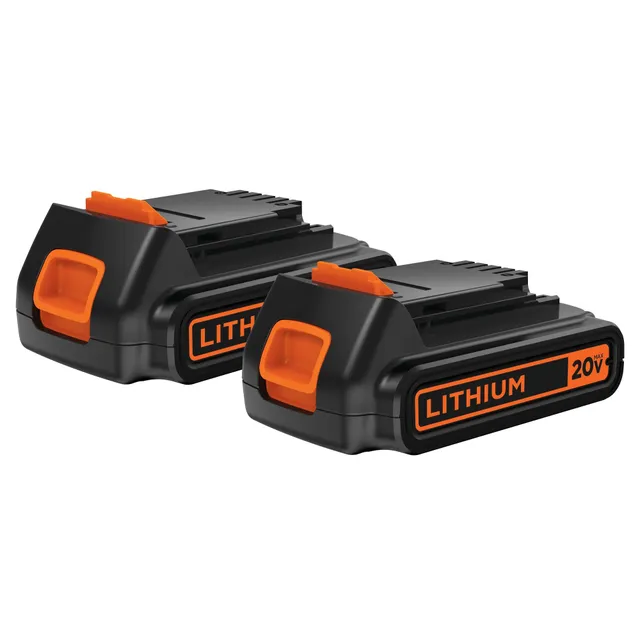
Using a third-party charger can save you a few bucks, but it comes with huge risks. Black+Decker chargers are designed to communicate with their specific battery pack to ensure optimal charging current and voltage. A knockoff charger might not provide the correct charging profile, which can lead to undercharging, overcharging, overheating, or even a fire. Don't gamble with your safety or your tools. Always use the charger that came with your tool or a genuine Black+Decker replacement.
This myth comes from the old days of nickel-cadmium (NiCd) batteries, which suffered from a “memory effect.” Lithium-ion batteries, on the other hand, are exactly the opposite. They prefer partial discharges to deep discharges. Running a lithium battery completely dead can permanently damage it, reducing its lifespan and capacity. It’s much better to recharge your lithium battery when it gets to around 20-30% remaining. This reduces stress and extends the overall life of the battery.
While they share the same battery platform, not all 20V MAX tools are equal. Black+Decker puts out a huge range, and there are distinct quality tiers. Some tools are basic, hobbyist-level models, while others are more robust, designed for more demanding DIY tasks. Don't assume that just because it says “20V MAX” it's the best tool. Read reviews, check the specs (like torque or RPM), and consider what you'll actually be doing with it.
You might have heard that you can't store lithium batteries in cold temperatures. The truth is that lithium batteries actually prefer cooler storage. High temperatures accelerate aging and can cause damage. The problem is freezing temperatures combined with charging. You should never charge a lithium battery that is below freezing (32°F), but storing it at 40-50°F is perfectly fine. So, yes, you can keep your batteries in the garage as long as you bring them inside to charge when it’s cold.
Sometimes a lithium battery can “fall asleep” due to its protective circuitry, often after being over-discharged. Some chargers have a “refresh” or “recondition” mode that can wake it up. Alternatively, you can sometimes jump-start it with a compatible charger for a few seconds. But be careful – if the battery is physically damaged or swollen, do not try to revive it. Dispose of it properly at a recycling center.
So, what’s the best approach? First, identify which platform your tools use. If you’re just starting out, the 20V MAX POWERCONNECT platform is the smart choice because it's the current standard and has the widest range of tools. If you already have older tools, stick with the platform you have, but be aware that you might have limited selection in the future.
Remember that higher Ah (amp-hour) batteries will give you longer run time but often come with a higher weight. A 1.5Ah battery is fine for a drill or a quick driver use, but if you're doing heavy work, consider investing in a higher-capacity battery.
Now that you know the truth, don’t let these myths slow you down. Use your Black+Decker tools with confidence, and if you need a reliable replacement battery, check out our 20V MAX POWERCONNECT 1.5Ah 2-pack. It's a smart investment that keeps your tools running.